Research
When an older adult grips hard while judging what they just heard or saw, something gives. This work asks what: the sensitivity of perception, the caution behind the response, or the quality of the evidence feeding the decision. Answering it takes more than accuracy and reaction time. It takes tools that can tell those three apart.
The setup
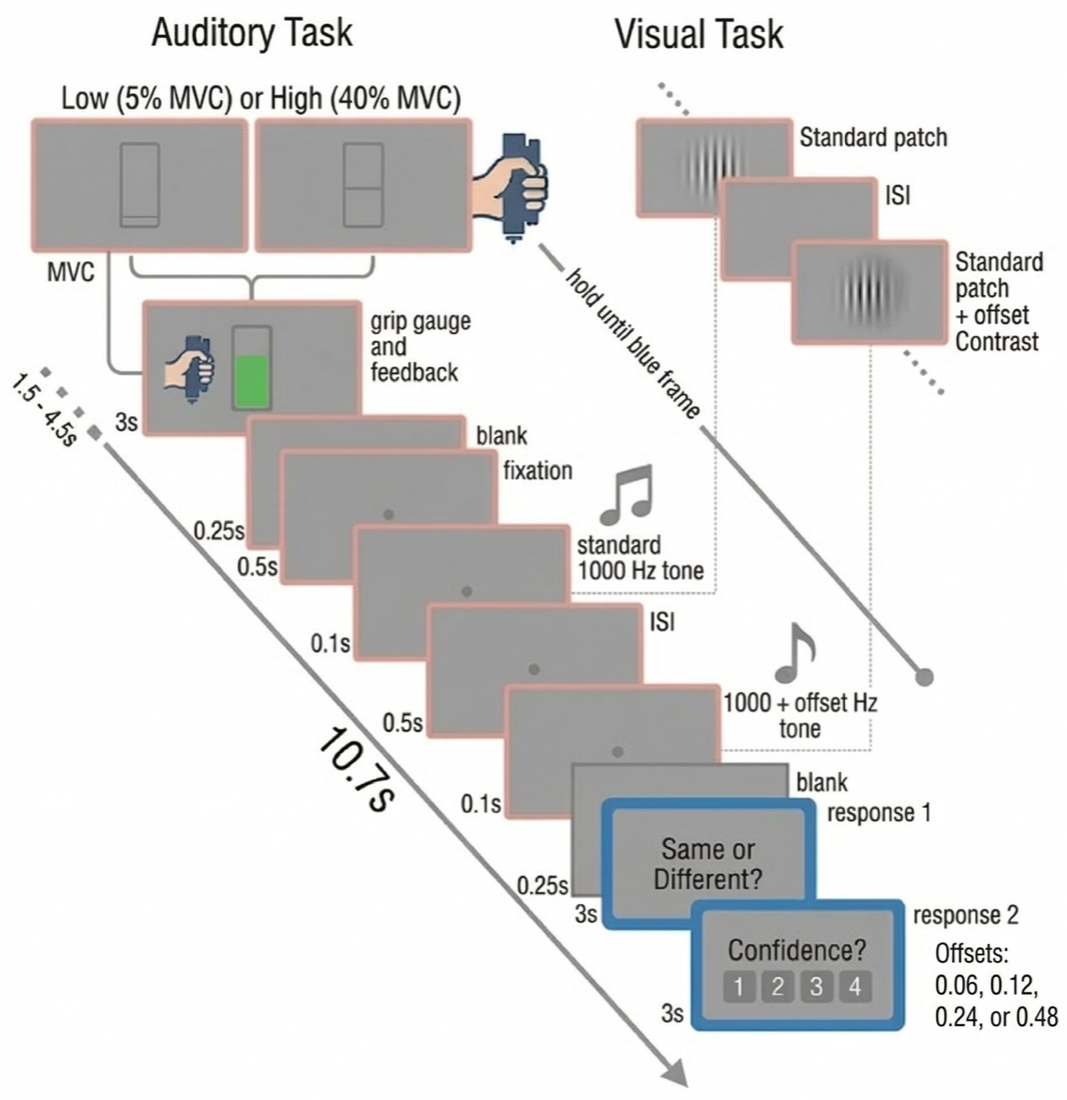
The backbone is a handgrip dual-task: participants hold a steady isometric force while making fine auditory or visual discriminations. Effort becomes an experimental dial on arousal; pupillometry tracks that arousal moment to moment; and modeling separates a change in what you can perceive from a change in how you decide. The paradigm is validated first in younger adults, then examined in older adults, where cognitive capacity is tighter and the physiological price of effort is steeper, through three complementary modeling lenses plus a fourth that reads the grip signal itself.
Collaboration footprint
Five labs plus shared neuroimaging infrastructure
This PhD research is conducted through an interdisciplinary network spanning psychology, bioengineering, cognitive neuroscience, and neuroimaging, with shared expertise and infrastructure supporting the broader research program.
- UC RiversideTwo Psychology labs
- UC RiversideOne Bioengineering lab
- UCL, formerly UC IrvineOne collaborating lab
- Northeastern UniversityOne collaborating lab
- UC RiversideCenter for Advanced Neuroimaging
Dissertation chapters are not journal articles; titles and status are listed on Publications.

This project was funded by the National Institutes of Health for research on cognitive aging.
The arc
Validate: younger adults
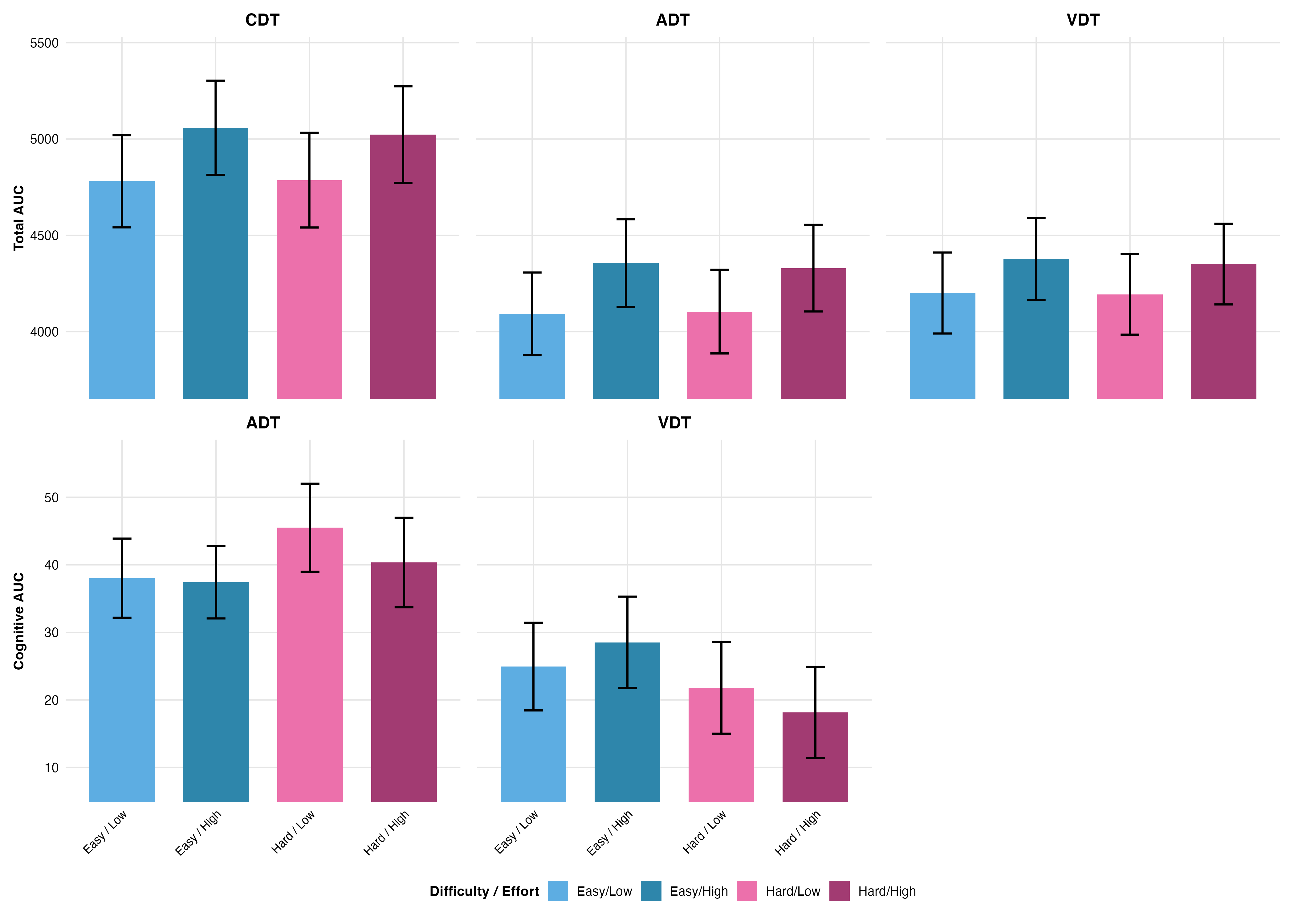
Does the handgrip actually move arousal? Yes. Across three concurrent tasks, pupil-linked arousal tracked the effort manipulation more clearly than summary behavior did. This established the measurement strategy the older-adult work depends on.
Takeaway: Grip raised arousal before it clearly hurt behavior.
Measure: perception under arousal
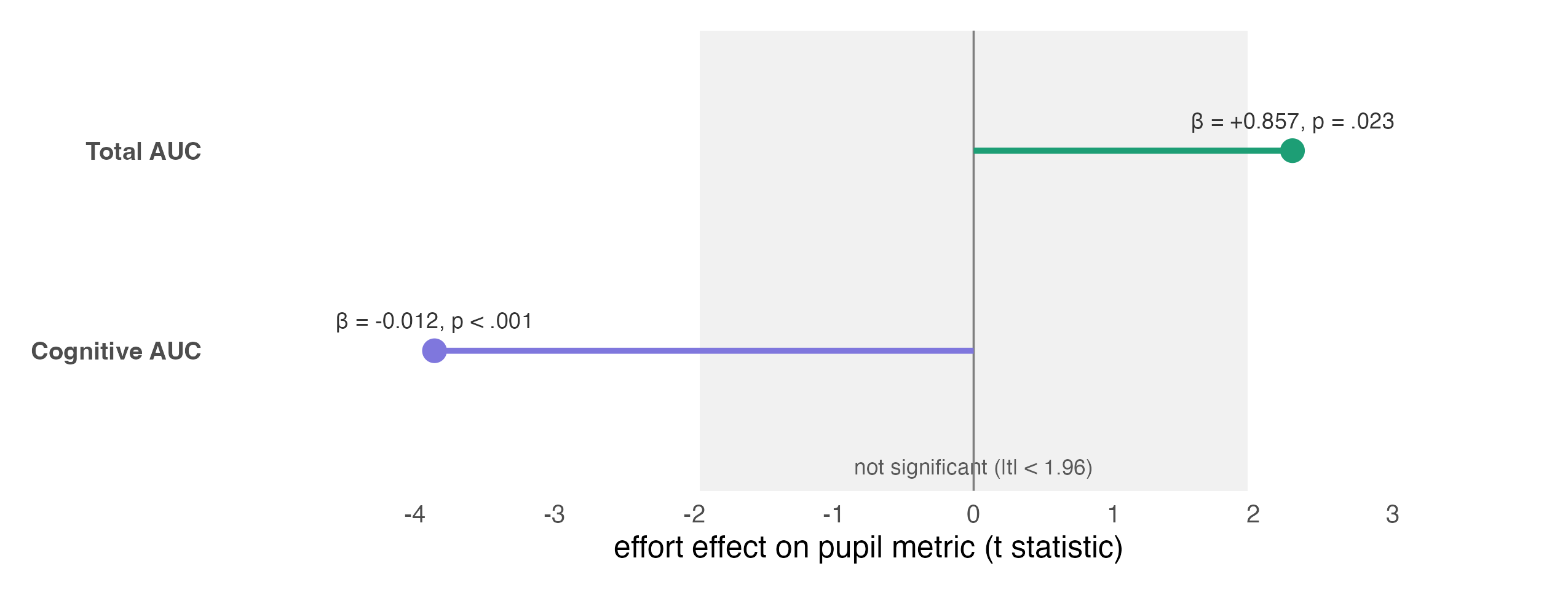
In older adults, does moment-to-moment arousal sharpen or blunt perception? Neither, measurably. Effort raised arousal and shifted how much people responded, but it did not tune the sensitivity of perception itself. The key move is that we could show that null was real, not just underpowered.
Takeaway: Effort changed how much people responded, not how sharply they perceived.
Model: where the cost lives
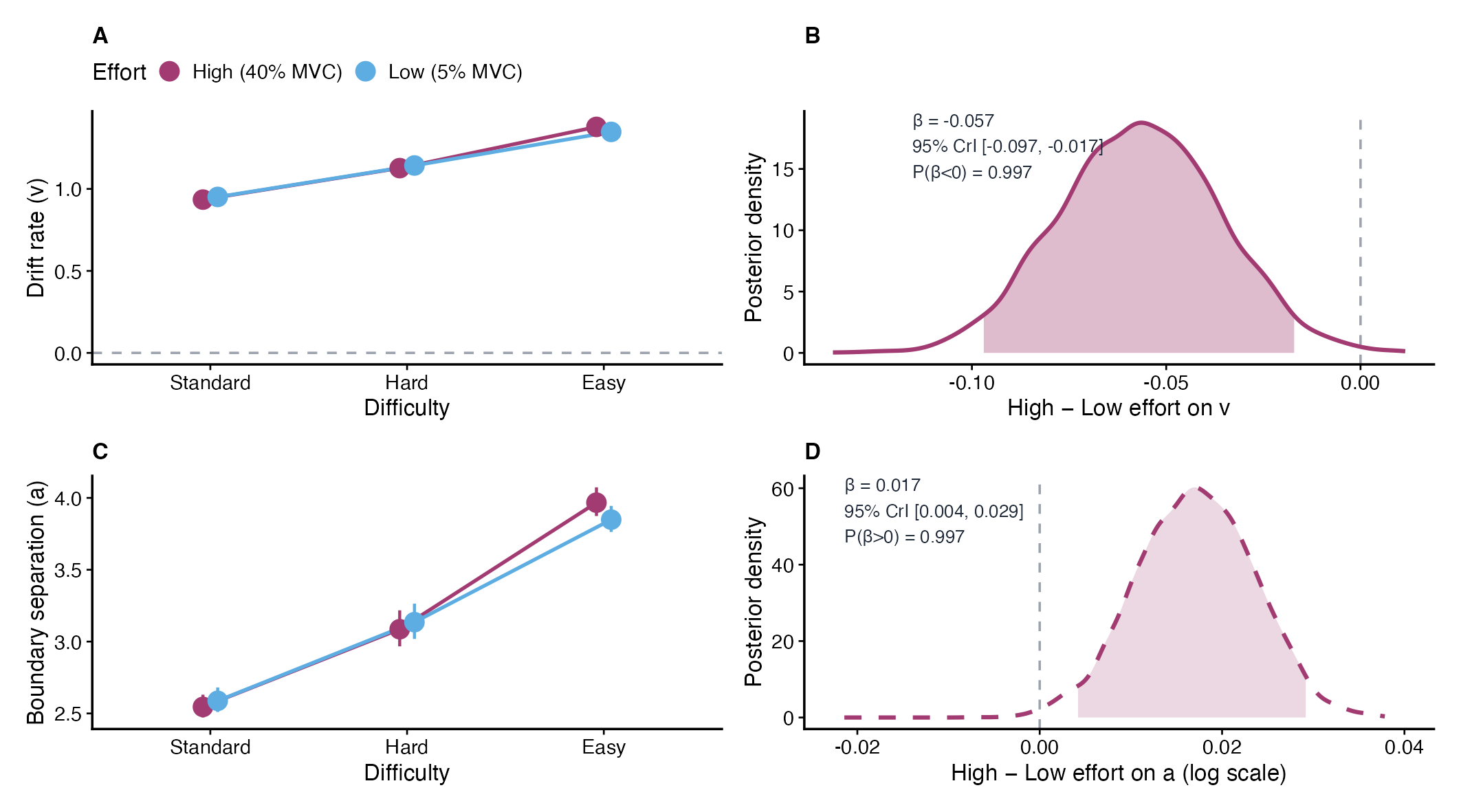
If effort costs performance, which part of the decision does it touch? A hierarchical Bayesian diffusion model gives the sharpest answer of the program: effort degrades the quality of evidence accumulation, not the caution or the bias behind the response. The cost is a slower, noisier read of the world rather than a change in strategy.
Takeaway: Effort made the sensory read noisier, not more cautious. Think: a shakier signal, not a more careful answer.
Motor: the grip as a signal
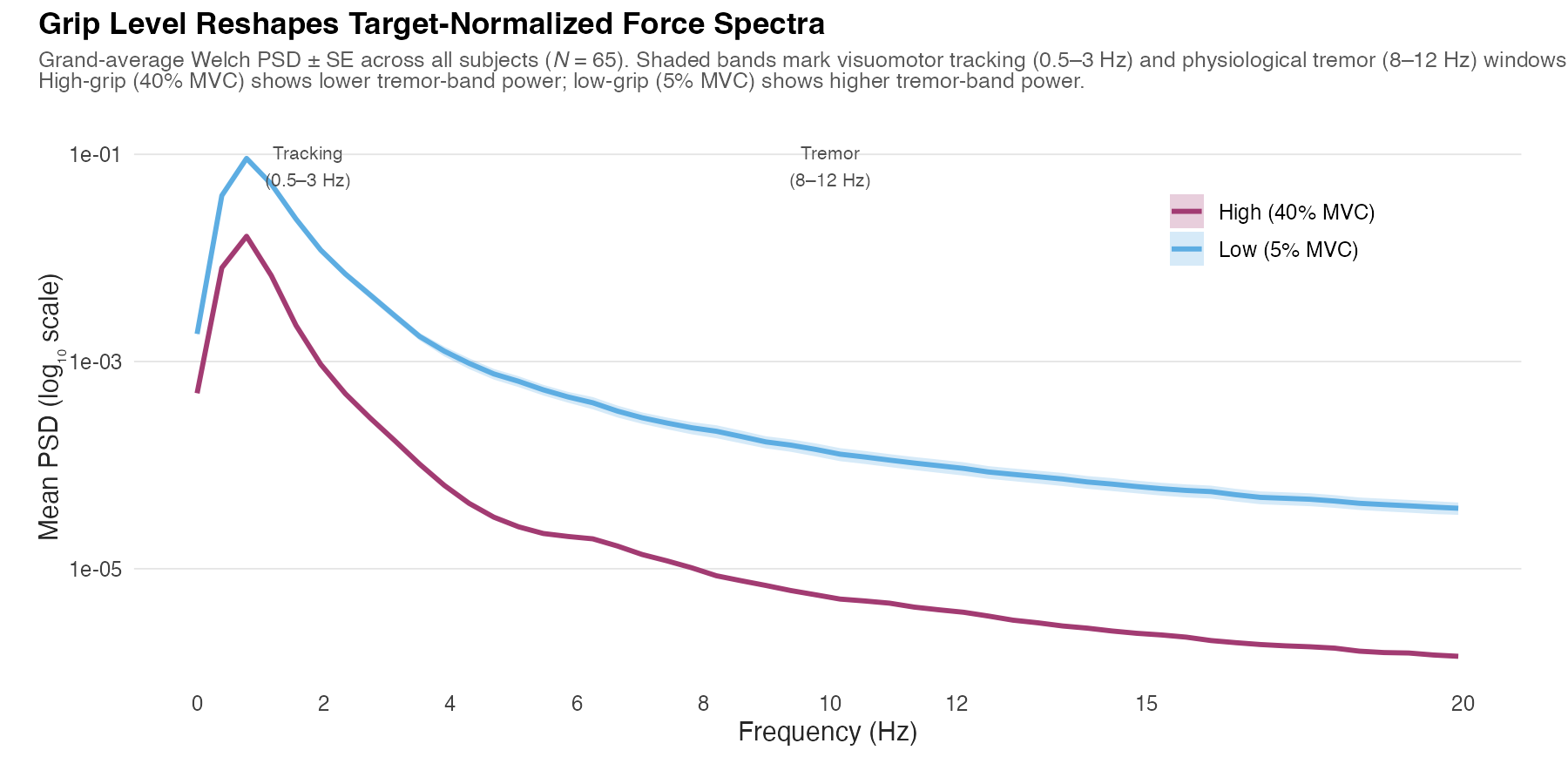
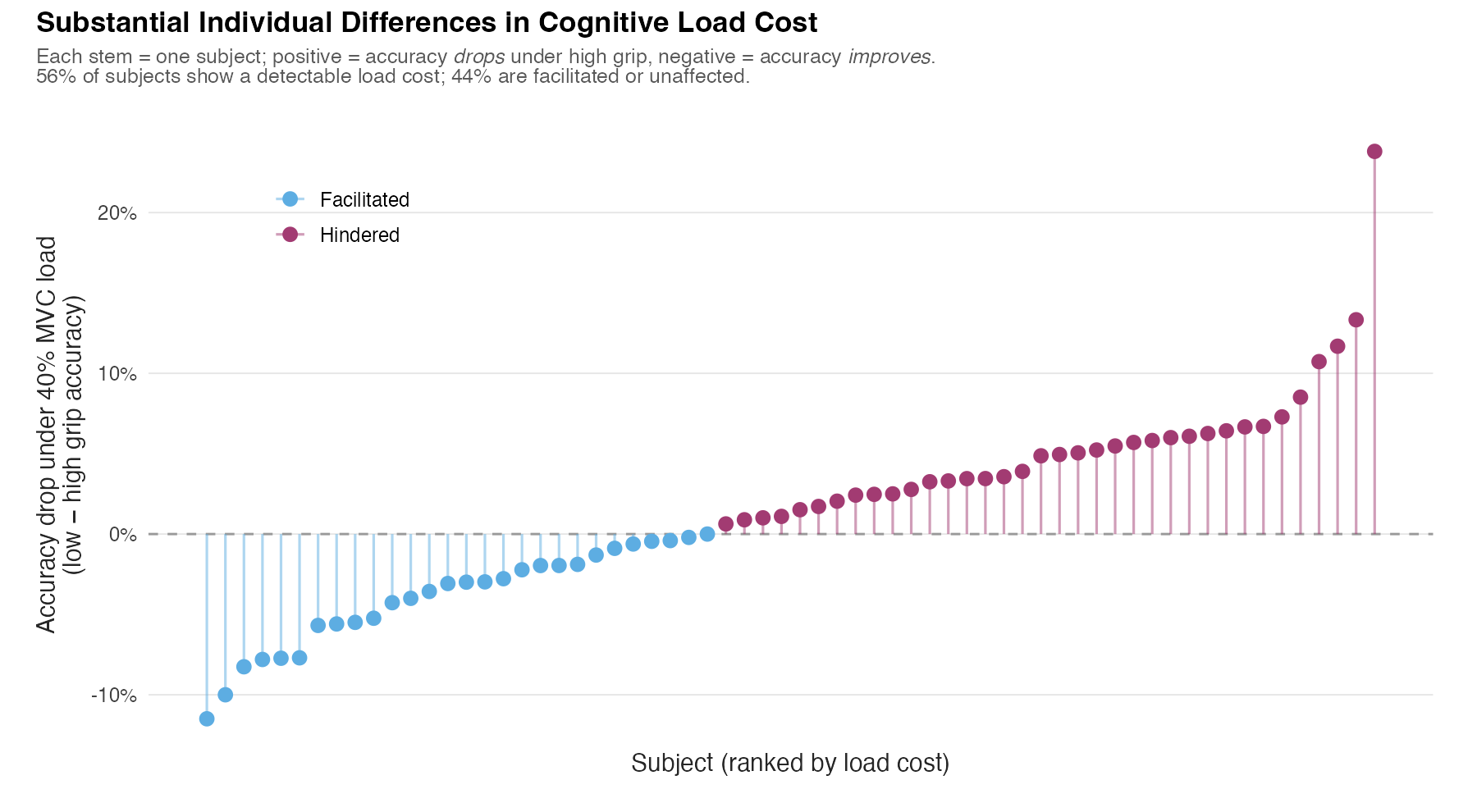
Can the grip itself reveal cognitive strain? The same paradigm, read through the dynamometer trace: sub-second grip tremor tracked perceptual errors trial by trial, and it did so equally under light and heavy force. This points to a general marker of neuromuscular-cognitive strain rather than an effort-specific artifact.
Takeaway: Fine grip tremor carries a trial-by-trial hint of cognitive strain, not just how hard you're squeezing.
The punchline
Under the limited capacity of aging, physical effort degrades the quality of the evidence feeding a perceptual decision while leaving the decision policy, caution, and bias largely intact. Where the program finds nothing, it says so with bounds, not shrugs.
Why it matters
Most accounts stop at whether effort hurts performance. This program says which component it touches and, just as usefully, which it spares. That distinction has teeth for systems meant to respond to a user’s cognitive state. If effort erodes evidence quality rather than caution, a state-aware interface should help by cleaning up the signal through clearer cues, better contrast, or more time, rather than by nudging a speed–accuracy tradeoff the user isn’t actually shifting. The work connects psychology, cognitive neuroscience, and human factors, without claiming clinical translation, production deployment, or pupillometry as a diagnostic biomarker.
Program overview: dual-task case study. Methods and computation: Skills.
The content of this website is solely the responsibility of the author and does not necessarily represent the official views of the National Institutes of Health.
Adjacent · arXiv preprint Independent study, not part of the NIH-funded program
Adjacent: gaze vs. hand pointing in XR
A separate, open-source line of work asks the dissertation’s question in a new place: when a pointing task gets hard, where does the cost show up, and does it differ by input channel? Using a web-based ISO 9241-9 target-acquisition task with a physiologically-grounded gaze simulation (not eye-tracking hardware), it compares hand and gaze selection under adaptive vs. static UI and time pressure.
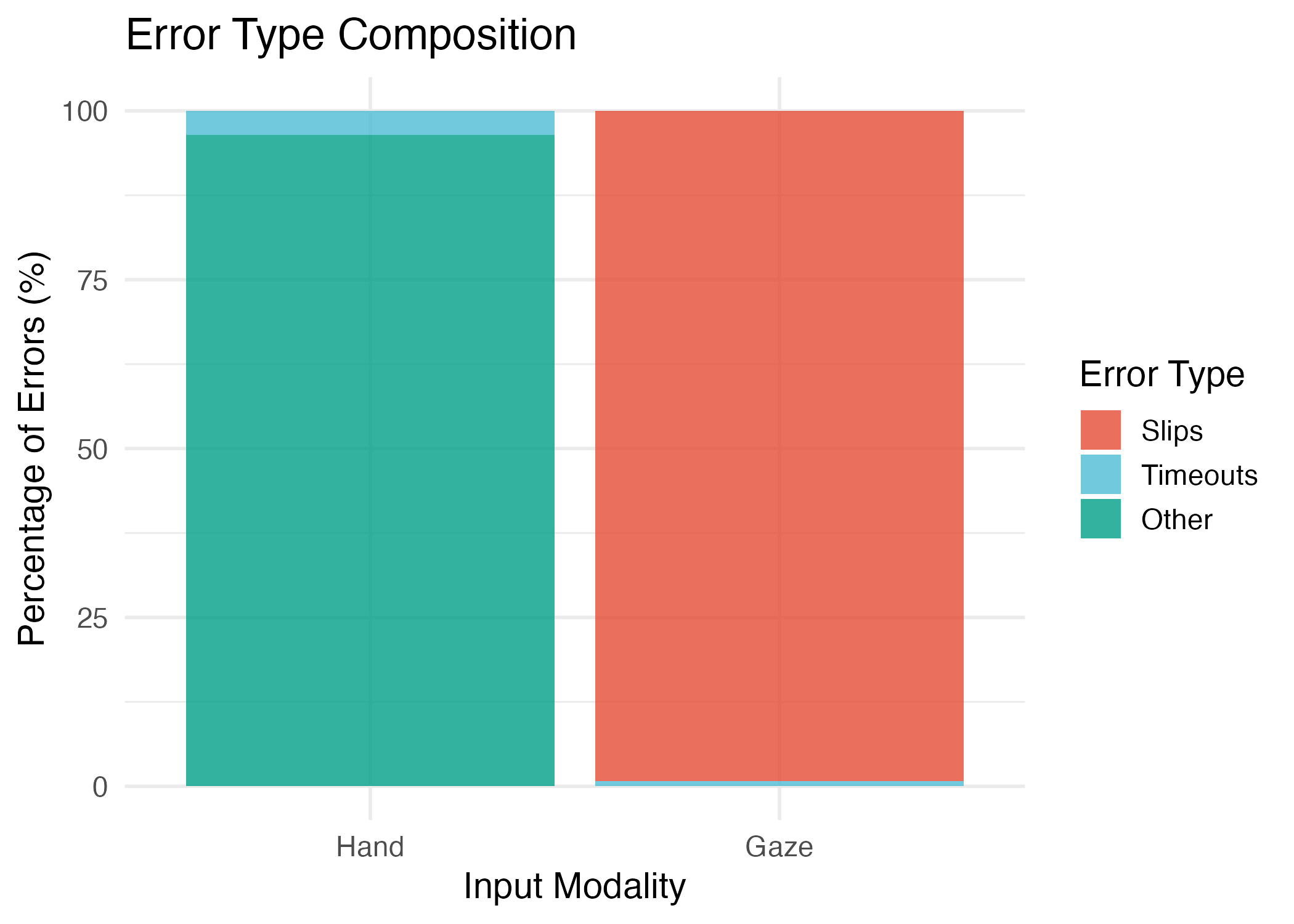
The signature result is a clean dissociation: the two modalities fail in opposite ways. Gaze errors are almost all slips (99.2%), or accidental activations from looking rather than intending, while hand errors are almost all misses (95.7%). That is the Midas Touch problem made measurable: gaze couples looking to see with looking to select. Modeling the verification phase with a hierarchical Bayesian LBA places gaze’s extra cost in the same kind of spot where the dissertation localizes effort: one stage of the decision, the commit step of deciding a look is a choice, rather than the movement itself.
Takeaway: Gaze fails by acting when you were only looking; hand fails by missing. Adaptive XR should target each modality's own failure mode rather than adapt generically.
The full treatment, including the remote testbed, spatial error maps, LBA parameter model, and an honest teardown of which adaptive policy actually executed, lives in the case study →. In brief, only one of two adaptive policies ran: gaze declutter trimmed timeouts, not slips. The telemetry also caught that hand target-inflation never executed. That is an instrumentation win, not a result. This line supports HCI and human-factors breadth; the dissertation remains the primary training identity.